This page has been written and reviewed by Attorney Michal Durakiewicz, founder of Durak Divorce and Family Law and a Tennessee State Bar licensed attorney since 2015. Michal represents people throughout Franklin, TN, in marital property division matters, including disputes involving retirement accounts, business valuation, and contested asset division.
Dividing property during divorce usually involves far more than deciding who keeps certain belongings. A Franklin marital property division lawyer helps individuals address disputes involving homes, retirement accounts, investments, businesses, and shared debt. Financial disagreements may quickly influence larger decisions connected to separation and future stability.
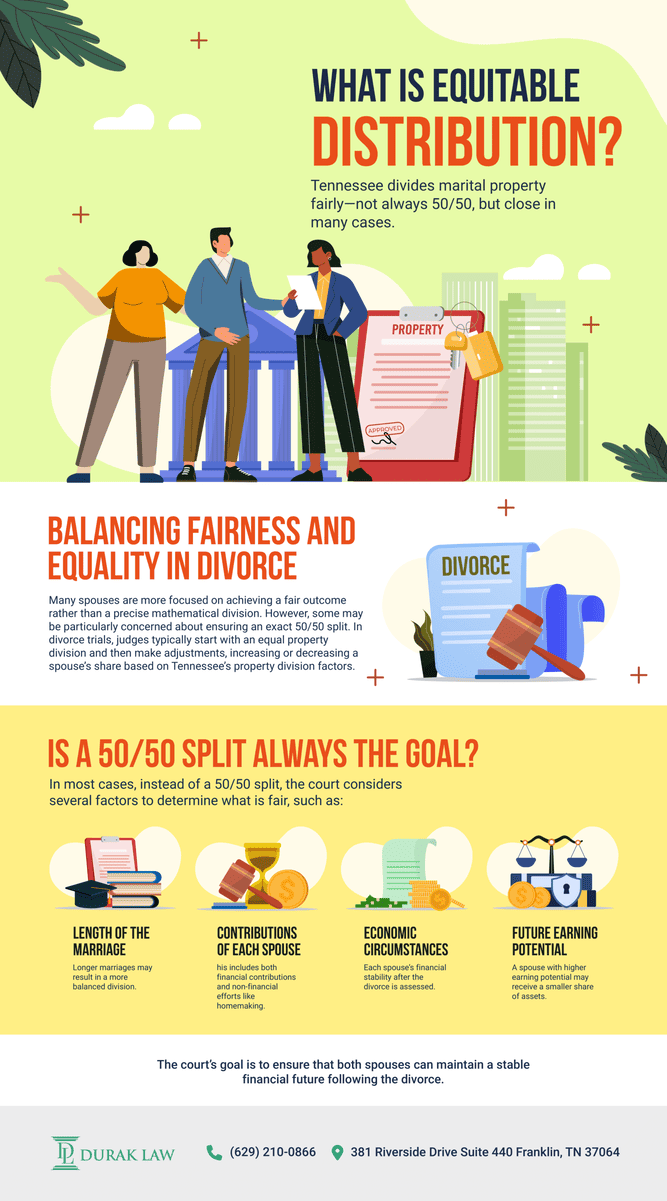
Tennessee uses equitable distribution rules rather than automatically splitting marital assets evenly between spouses. Under Tenn. Code Ann. § 36-4-121, courts review several financial and marital factors when deciding what property division appears fair under the circumstances. Disagreements may arise over property classification, debt allocation, or the valuation of major financial assets.
Some disputes involve claims that certain property remained separate throughout the marriage. Others focus on retirement savings, investment growth, hidden assets, or ownership interests in a business. As financial questions become more complicated, spouses may turn to a family law attorney in Franklin to help address increasingly difficult negotiations and protect their financial interests.
Property division decisions may affect housing arrangements, retirement planning, debt responsibilities, and future financial security. When private negotiations break down, unresolved matters may proceed through review in Williamson County Chancery Court, where judges evaluate disputed financial and property division issues under Tennessee divorce law. Financial records, account history, and supporting documentation usually become important during this stage.
Durak Divorce and Family Law helps individuals throughout Franklin and Williamson County, handling property-related divorce disputes and related family law matters. We help clients understand how Tennessee courts evaluate marital assets, financial obligations, and property classification issues. Careful preparation and early review may help reduce unnecessary conflict during the divorce process.

Classifying Marital and Separate Property
Assets Commonly Classified as Marital Property
Income earned during the marriage is commonly treated as marital property during Tennessee divorce proceedings. Courts often examine pay records and financial statements to understand how shared income supported the household and contributed to marital finances over time.
Several types of property may become part of the marital estate, including jointly acquired homes, retirement accounts, shared investment portfolios, and marital debt obligations. Mortgage payments, property improvements, and shared financial contributions sometimes influence how ownership interests are evaluated during litigation.
Retirement-related disputes may involve:
- pensions accumulated during the marriage
- employer-sponsored retirement plans
- investment growth tied to marital contributions
Courts generally review whether the value of these assets increased while the marriage remained legally intact.
Debt allocation can become just as important as dividing assets themselves. Credit card balances, loans, and other financial obligations may significantly affect how courts structure an overall property division outcome. Tennessee courts review the broader financial circumstances before determining equitable division of marital property.
Separate Property and Commingling Disputes
Separate property generally includes assets owned before the marriage began. Certain inheritances and personal gifts may also remain separate property under Tennessee law. These assets sometimes become the subject of dispute when financial records are incomplete or ownership history is unclear.
Premarital agreements may help protect certain assets from becoming marital property during divorce proceedings. Courts often review these agreements carefully before deciding how property should be classified. Disputes may still arise when spouses disagree about the agreement’s validity or interpretation.
Appreciation involving separate property may create additional financial disputes in divorce cases. Courts sometimes evaluate whether marital income, labor, or financial support contributed to the asset’s increased value over time. These situations frequently involve homes, businesses, investment accounts, or other high-value property interests.
Commingled property disputes often develop when separate and marital assets become financially connected during the marriage. Shared deposits, renovations, or joint account activity may complicate ownership claims later in the divorce process. Early financial documentation often becomes important when resolving these complex property classification issues.
Valuing Homes, Businesses, and Investments
Property Valuation Disputes During Divorce
Property valuation disputes often become major issues during divorce because the assigned value of marital assets may directly affect each spouse’s financial future after the marriage ends. Once valuation disagreements begin, settlement negotiations involving larger assets may quickly become more difficult.
Real estate disputes frequently involve questions about:
- mortgage balances
- available equity
- current market conditions
- ownership interests between spouses
Marital homes and investment properties often become central points of disagreement when spouses dispute present value or future resale potential.
Commercial real estate and closely held businesses may create an entirely different level of financial complexity. Family-owned companies, professional practices, and business partnerships sometimes require a detailed accounting review before courts can accurately evaluate ownership interests and future income implications.
How Courts Evaluate Property Value
Financial evidence often helps courts evaluate disputed marital asset values during divorce proceedings. Tax returns and financial statements may help establish income history and ownership interests. Courts frequently review these records before determining how marital assets should be valued and divided.
Property appraisals may also influence how courts evaluate homes, commercial real estate, and investment properties during divorce disputes. Appraisers often examine market conditions, property condition, location, and comparable sales before determining the estimated value.
Business valuation reports are commonly used when divorce proceedings involve family-owned companies or professional practices. Financial experts may review revenue history, operating expenses, ownership structure, and future earning potential before offering opinions regarding the company’s value.
Similar financial analysis may also help courts evaluate complicated disputes involving investment accounts, debt obligations, and other high-value marital assets. These reviews often become important when spouses disagree about ownership interests or accurate property valuation.

Retirement Accounts and Shared Debt Division
Division of Retirement and Investment Accounts
Retirement accounts often become one of the most financially significant issues in Tennessee divorce proceedings. Courts may examine retirement assets accumulated during the marriage, including 401(k) plans, pensions, IRAs, and other long-term savings accounts that may affect future financial stability after divorce.
In many cases, disputes center on two questions:
- Which portion of the account qualifies as marital property
- How the retirement assets should ultimately be divided
Courts generally focus on retirement contributions and investment growth accumulated while the marriage remained legally intact. Disagreements sometimes arise regarding contribution history, account valuation, or claims that part of the account should remain separate property.
Division of retirement assets often requires a Qualified Domestic Relations Order (QDRO). These court-approved orders help retirement plan administrators transfer funds in accordance with the divorce agreement or final court ruling. Missing or incomplete documentation may delay distribution and create additional financial complications during the transfer process.
Responsibility for Shared Debt After Divorce
Shared debt division may continue affecting both spouses long after the divorce itself becomes final. Mortgage obligations, credit card balances, personal loans, and other liabilities often remain major financial concerns during property division proceedings because courts must determine how responsibility for those debts should be allocated moving forward.
Mortgage-related disputes commonly involve questions such as:
- who will remain in the marital home
- whether refinancing will be required
- how future payment responsibility will be handled
These issues sometimes become more complicated when both spouses remain legally connected to the original loan agreement.
Vehicle financing and joint credit card balances may create separate financial risks after the marriage ends. Even when a divorce agreement assigns responsibility to one spouse, lenders and creditors may still treat both parties as legally responsible for unpaid balances in certain situations.
Hidden Assets and Financial Disclosure Problems
Concealed Property and Missing Disclosures
Financial disclosure issues can quickly complicate property division disputes during divorce. Hidden accounts, undisclosed investments, and incomplete records may affect how courts evaluate marital assets and financial obligations between spouses.
In other situations, disagreements arise when one spouse allegedly understates property values or fails to disclose certain financial interests. These issues may significantly affect settlement negotiations and property division decisions.
Missing financial documentation may also create problems when courts attempt to evaluate marital property and debt obligations. Bank statements, investment records, and business documents sometimes become difficult to obtain during contested divorce proceedings.
Ownership disputes frequently develop when incomplete records prevent clear identification of marital and separate property interests. Courts may review financial history, account activity, and supporting evidence before making property division decisions.
Asset Tracing and Documentation Challenges
Asset tracing disputes often develop when financial records become incomplete, delayed, or difficult to verify during divorce proceedings. Before deciding whether property should be classified as marital or separate, courts may require additional documentation supporting ownership history and financial tracing.
Separate property disputes frequently involve assets such as inherited funds, investment accounts, or financial interests that remained partially mixed with marital finances during the marriage. Over time, clear separation sometimes becomes difficult to prove when records are inconsistent or ownership history is unclear.
Courts may also face challenges when valuation evidence is incomplete. Missing documentation can interfere with efforts to determine:
- accurate property values
- investment account balances
- ownership percentages
- financial liabilities connected to disputed assets
When reliable information remains unavailable, judges sometimes require additional financial review before entering final property division decisions.
Poor recordkeeping may continue creating problems long after the divorce concludes. Incorrect valuations, undisclosed debt, or incomplete financial disclosures can affect ownership rights and future financial obligations for both spouses, making careful documentation especially important during complex property disputes.
Resolving Marital Property Disputes in Court
Negotiated Property Settlements and Mediation
Many marital property disputes are resolved through negotiation before reaching a contested court hearing. Financial disclosures often play an important role in settlement discussions involving property and debt allocation. These discussions may help spouses better understand the financial issues affecting the divorce proceedings.
Mediation is also commonly used in contested divorce matters involving disputed marital property and financial obligations. During mediation, both parties may work with a neutral mediator to discuss possible settlement terms. This process often allows spouses to address disagreements in a more controlled and private setting.
Proposed settlement agreements frequently involve the division of property, retirement accounts, debt obligations, and investment interests. These agreements may also address responsibility for mortgages, credit accounts, and other shared financial liabilities. Accurate financial documentation may help both parties evaluate whether proposed settlement terms remain practical and balanced.
Courts may still review negotiated settlements before approving final property division terms during divorce proceedings. Judges often examine whether the agreement appears fair and complies with Tennessee law before entering final orders. Premarital agreement disputes may also arise when spouses disagree about enforceability during divorce proceedings.
Court Decisions Involving Disputed Assets
Some property disputes eventually proceed to court after negotiations and mediation fail to resolve ongoing financial disagreements between spouses. Litigation may involve contested issues surrounding homes, businesses, retirement accounts, or investment property, particularly when both parties strongly disagree about ownership interests or valuation.
During contested proceedings, judges often review a wide range of financial evidence, including:
- tax returns
- appraisal reports
- valuation testimony
- ownership documentation
- financial statements
These materials may become especially important when spouses present conflicting claims regarding marital assets or debt obligations.
Complex financial disputes sometimes require outside professionals to participate in the litigation process. Accountants, appraisers, and valuation experts may analyze business records, investment portfolios, or property values before presenting financial opinions to the court. Their analysis can help judges evaluate disputed evidence more accurately before issuing final rulings.
How a Marital Property Division Lawyer Can Help
Disputes Over Ownership and Property Value
Marital property disputes often involve complicated financial questions affecting long-term financial stability after divorce. Legal representation may help individuals better understand how Tennessee courts evaluate disputed property and debt obligations.
Ownership disputes sometimes arise when spouses disagree about property classification or the history of financial contributions during the marriage. Financial records, account activity, and property documentation may help identify disputed ownership interests during divorce proceedings.
Reviewing financial disclosures may also help identify inaccuracies that affect property division negotiations or court proceedings. Some disputes involve hidden accounts, undervalued assets, or incomplete financial documentation during the divorce process.
Challenging inaccurate valuations may also become important when property values appear inconsistent or unsupported by financial evidence. Asset valuation disputes sometimes affect homes, businesses, retirement accounts, and investment property during contested divorce proceedings.
Preparing for Contested Property Division Litigation
Contested property division cases often require extensive negotiation, financial review, and court preparation before disputes can be resolved. Proposed settlements may involve retirement accounts, debt allocation, refinancing obligations, and other long-term financial responsibilities that deserve careful evaluation before either spouse agrees to final terms.
As litigation progresses, financial preparation usually becomes more detailed. Courts may rely heavily on documents such as valuation reports, ownership records, financial statements, and debt documentation when reviewing contested property claims. If the available evidence appears incomplete or inconsistent, additional financial review may be required before the case can move toward resolution.
Some disputes become especially complicated when they involve:
- closely held businesses
- investment property
- professional practices
- large marital assets with disputed valuation
In these situations, accountants or valuation professionals may provide analysis intended to clarify ownership interests and disputed financial values before negotiations or hearings continue.
Property disputes may continue affecting financial stability long after the divorce itself becomes final. Shared liabilities, refinancing obligations, mortgage debt, and future payment obligations can create ongoing financial pressure for former spouses, particularly when the divorce agreement fails to fully address long-term financial risks.
Frequently Asked Questions About Marital Property Division in Tennessee
Is Marital Property Split Equally in Tennessee?
Not always. Tennessee follows equitable distribution rules, which means courts focus on a fair division rather than automatically dividing everything equally. Judges may review financial circumstances, marital contributions, and property ownership before making decisions.
Can Property Owned Before Marriage Be Divided?
Usually, property owned before marriage is considered separate property. However, disputes may arise if marital income, shared efforts, or joint investments increased the property’s value during the marriage.
Who Gets the Marital Home During Divorce?
The marital home may be awarded to either spouse, depending on the financial and family circumstances involved. Courts may review custody arrangements, mortgage obligations, and each spouse’s ability to maintain the property after divorce.
Are Retirement Accounts Divided During Divorce?
Yes, retirement accounts earned or increased during the marriage are often considered during property division. Courts may review pensions, 401(k)s, investment growth, and retirement contributions before deciding how those assets should be divided.
What if a Spouse Hides Assets During Divorce?
Hidden assets can create serious disputes during divorce proceedings. Courts may review bank records, tax returns, investment accounts, and financial disclosures if there are concerns about concealed property or incomplete information.
Who Pays Shared Debt After Divorce?
Tennessee courts generally divide marital debt according to each spouse’s financial circumstances and responsibility for the obligation. Even after divorce, both spouses may remain connected to certain debts if their names still appear on the original loan or credit agreement.
Are Prenuptial Agreements Enforceable in Tennessee?
Yes, prenuptial agreements may be enforceable when they meet Tennessee legal requirements. Courts often review whether both spouses signed the agreement voluntarily and whether proper financial disclosure occurred before the marriage.
Contact a Franklin Marital Property Division Lawyer
Property division during divorce can become complicated when spouses disagree over ownership, account balances, debt responsibility, or the value of major assets. Retirement funds, real estate, business interests, investment accounts, and shared liabilities may all affect financial security after the marriage ends. Disputes surrounding disclosure, valuation, or asset classification can also shape settlement negotiations and court decisions throughout the case.
Durak Divorce and Family Law helps individuals handling divorce-related financial disputes involving marital property, business assets, retirement accounts, real estate, and shared debt obligations. Our firm works with clients to review financial records, address contested ownership issues, and prepare for decisions that may affect long-term financial stability after divorce. Contact us today or call (629) 210-0866 to discuss your property division matter and speak with an attorney about the financial issues involved in your case.